
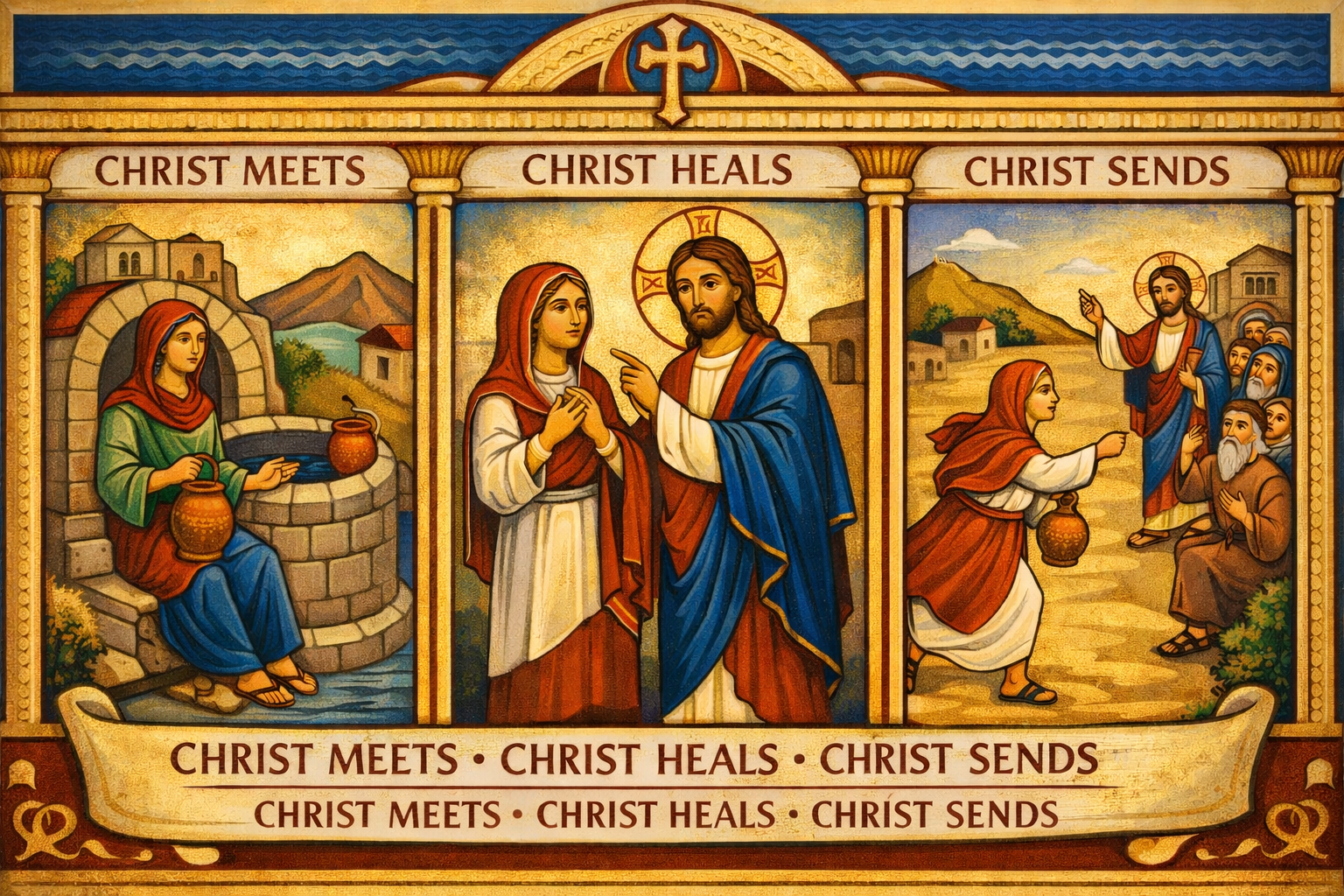
The Samaritan Woman: Raised with Christ, Remembered by God
In the Name of the Father, and the Son, and the Holy Spirit, One God. Amen.
May the blessing of the Father who calls us, and His Only Begotten Son who saves us, and the Holy Spirit who sanctifies and transforms us be with us all — that we may hear His word and bear fruit, thirty, sixty, and a hundredfold. Amen.
Have you ever felt like you were stuck with a label?
Not a label someone put on your shirt — but one that got stuck to your name. The way certain people look at you. The feeling that no matter what you do, or how much time passes, some people will always see you a certain way.
Maybe right now, sitting in this pew, there is something you are carrying. Something from your past, or something from your present, that makes you feel like everyone else got a clean start — and somehow yours never came.
And here is what I want to say before anything else:
You did not come here this morning to be reminded of it.
But I believe God brought you here this morning because of it.
Because some of us have been carrying this for a long time. Not a season. Not a year. A long time. And after that long, something quietly shifts inside you. You stop believing that change is really possible — not because you doubt God in your head, but because you have prayed this prayer before. You have stood at this altar before. You have made this promise before. And you woke up the next morning feeling exactly the same.
If that is where you are this morning, I want you to know that this sermon is for you.
The Church places before us today a woman who lived exactly like that.
She comes to the well alone. At the sixth hour — noon — when the sun is at its highest and the roads are empty. Every other woman in her town came in the morning, together, when it was cool. She does not come then. She waits. She comes alone, in the heat, when no one is there.
Not because she likes the heat.
Because she has learned that it is easier to hide than to be seen.
And yet — when she arrives — Christ is already there. Waiting. Not by accident. He came to that well, at that hour, for her.
Point One — You Are Not Your Past
The Apostle Paul opens our readings this morning with words that should shake us:
Colossians 3:1–3 — “If then you were raised with Christ, seek those things which are above, where Christ is, sitting at the right hand of God. Set your mind on things above, not on things on the earth. For you died, and your life is hidden with Christ in God.”
Not — you should try harder. Not — you need to do better. He says the old person, the one defined by shame, by failure, by that label — that person died with Christ.
And then he says something even more extraordinary: “your life is hidden with Christ in God.”
Hidden. Kept. Protected. Not exposed for the world to define. Hidden in God.
“We have been made one with Him through the Spirit, so that we who were imprisoned by corruption are set free and raised to a new dignity.”
— St. Cyril of Alexandria, Commentary on John
The Samaritan woman had a label. Five husbands. A broken life. A reputation her entire town knew. But notice what Christ does when He meets her. He does not begin with her sin. He begins with her worth. He asks her for a drink. He treats her as someone worth speaking to, worth stopping for, worth the journey.
“Your past is a place you visited. It is not a name you carry.”
Point Two — God Is Greater Than Your Condemning Heart
But perhaps you are sitting here thinking — I know this. I have heard this. I believe it with my mind. But I do not feel it. My heart does not feel it.
Saint John answers you directly this morning:
1 John 3:20 — “For if our heart condemns us, God is greater than our heart, and knows all things.”
Your heart condemns you. It reminds you of everything. Every mistake. Every failure. Every moment you wish you could take back. Every prayer that felt unanswered. Every time you promised to change and did not. Your heart keeps the record. It replays it. And after enough years of that, you begin to believe that the record your heart keeps is the truth about who you are.
But John says: God is greater than your heart.
He does not say your heart is wrong to feel what it feels. He does not dismiss the weight of it. He simply says: the God who made you is bigger than the record your heart keeps. He knows everything your heart knows — and more — and He has not turned away.
“Thou awakest us to delight in Thy praise; for Thou madest us for Thyself, and our heart is restless, until it repose in Thee.”
— St. Augustine, Confessions, Book I
And when she finally stood before the One who could fill it — He did not shame her. She said: “I have no husband.” Five words. A lifetime of grief in five words. And Christ said: “You have well said.” He honored her honesty. He did not crush her with it.
Because healing always begins when truth finally meets love.
“God knows everything about you. And He still chose not to walk away.”
Point Three — Your Wound Can Become Your Witness
Now watch what happens.
Saint Peter stands before a room full of people in the Acts of the Apostles and says:
Acts 10:39–41 — “And we are witnesses of all things which He did both in the land of the Jews and in Jerusalem, whom they killed by hanging on a tree. Him God raised up on the third day, and showed Him openly, not to all the people, but to witnesses chosen before by God, even to us who ate and drank with Him after He arose from the dead.”
Now look at the Samaritan woman again:
John 4:28–29 — “The woman then left her waterpot, went her way into the city, and said to the men, ‘Come, see a Man who told me all things that I ever did. Could this be the Christ?'”
Not a polished sermon. Not a theological argument. Just: come and see.
And I know there is someone here this morning who is thinking: that is a beautiful story, but I am not there yet. I do not have a transformation story to tell. I am still in the middle of it. I am still walking to the well. I cannot point to a moment and say — that is when everything changed.
I want to say something to you directly.
You do not need to be on the other side to be a witness. You only need to be honest about where you are. “Come and see a Man who is still working on me” is a testimony. “Come and see a Man who met me at my lowest and has not left” is a testimony. The woman did not wait until she was whole. She testified from the wound, while the wound was still fresh.
“Seest thou how she was not ashamed? She that had been hiding herself for shame now runneth to the whole city, and calleth all to her.”
— St. John Chrysostom, Homilies on John, Homily XXXIV
“The place you were hiding from is the very place God will send you back to — with a message.”
Point Four — Heaven Has Never Lost Your Name
And then the Psalm. Just two verses. Simple. Almost quiet after everything we have heard. But carry them carefully:
Psalm 115:12–13 — “The Lord has been mindful of us; He will bless us; He will bless the house of Israel; He will bless the house of Aaron. He will bless those who fear the Lord, both small and great.”
In the Hebrew, this word — mindful — means to remember in a way that leads to action. When God remembers in Scripture, things happen. When God remembered Noah, the waters receded. When God remembered Rachel, she conceived. This is not a passive memory. This is God turning His face toward you and moving.
And the Psalm says: He will bless both small and great. Not only the righteous. Not only the prominent. Both. All who turn toward Him, however broken, however far they have walked.
The Samaritan woman had been forgotten by people who should have remembered her. But God had not forgotten. God sent His Son to sit at a well, at noon, in the heat, to wait for one woman who thought she was invisible.
“You may feel forgotten. But Heaven has never lost your name.”
The Climax — She Is All of This
She came to draw water and left as living water.
She came in shame and left as a preacher.
She came alone and returned with a city.
And the result?
John 4:39 — “And many of the Samaritans of that city believed in Him because of the word of the woman who testified, ‘He told me all that I ever did.'”
Three Things to Carry Home
1. Leave your waterpot.
This week, sit before God — even five minutes — and name the thing you are still carrying. Not to confess it for the hundredth time. Just to lay it down. Say: I have been carrying this. I am leaving it here. And then rise and walk away without it.
2. Answer your condemning heart.
When your heart says you are not enough — answer it. Say out loud: God is greater than my heart. Not as a feeling. As a fact. Say it until it becomes the louder voice.
3. Say something.
You do not need to be whole. You do not need to have the full story yet. Find one person this week — one — and say: come and see what God is doing in my life. That is all. Come and see.
Closing
The Church has given her a name in our tradition. She is called Photini — the luminous one. The woman of light. She who was once hidden in the heat of the day became, according to tradition, a martyr, giving her life for the Gospel she ran to proclaim.
But she began with no name. Only a label.
And Christ met her at a well and gave her a new one.
He is still at that well this morning. He is not tired of waiting. He is not surprised by what you carry. He already knows — and He came anyway.
John 4:10 — “If you knew the gift of God, and who it is who says to you, ‘Give Me a drink,’ you would have asked Him, and He would have given you living water.”
May the Lord bless us and transform us — that our homes may stand on the Rock, our hands may serve in the harvest, and our hearts may long for Heaven. Through the prayers of our Lady, the Theotokos Saint Mary, and Saint Peter and Saint Andrew. Glory be to God forever. Amen.