
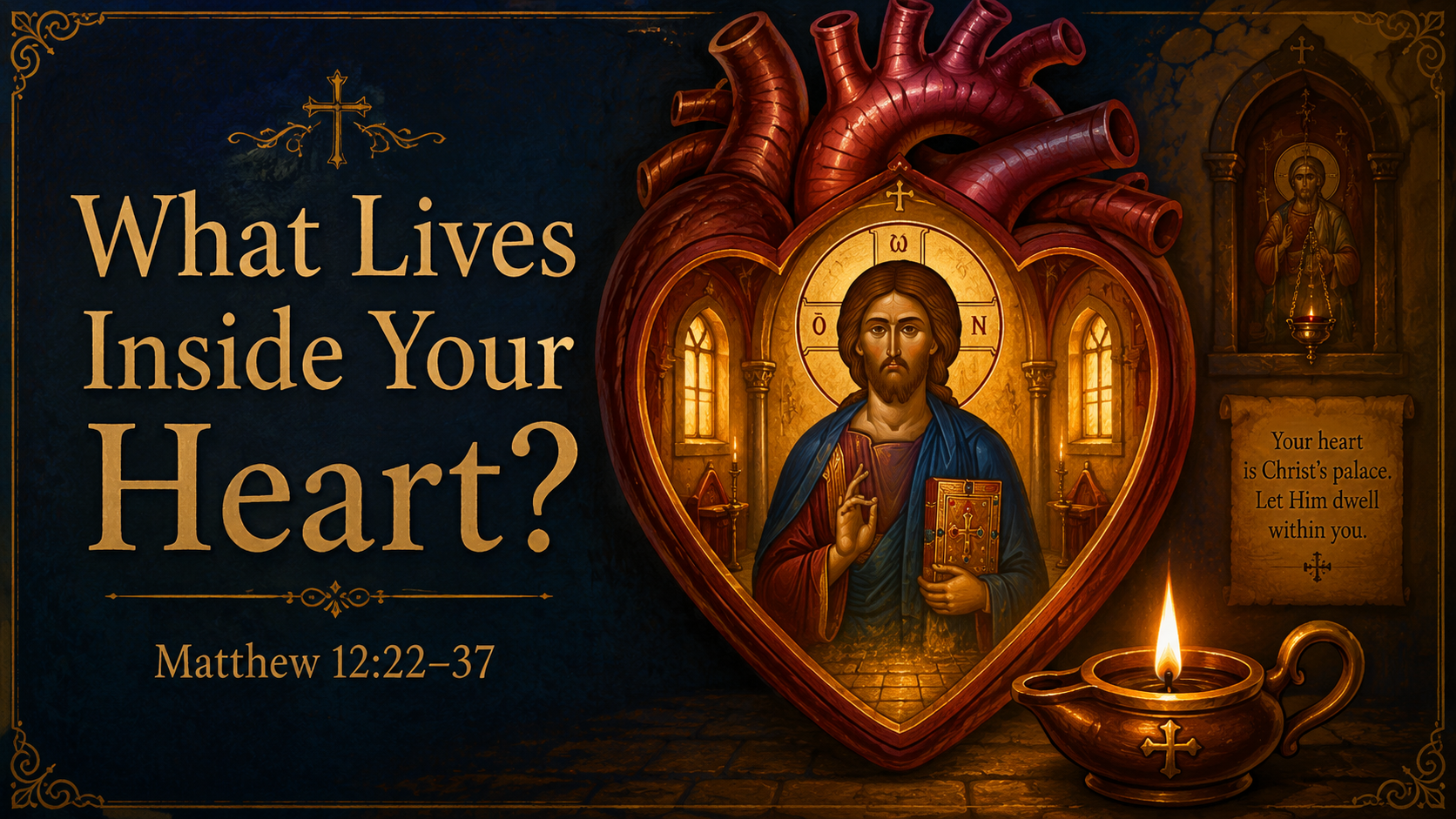
What Lives Inside Your Heart? – Matthew 12:22–37
“Jesus did not come merely to clean your heart; He came to make it His dwelling place.”
My beloved,
Have you ever walked into a beautiful home that looked absolutely perfect? The paint was fresh. The furniture was elegant. Every picture hung exactly in place.
Then, a few months later, the owners discovered termites. The walls still looked beautiful — but inside the wooden beams, something had been eating away at the house for a long time. The damage was never visible from the outside. It was happening where no one was looking.
I wonder if that is not a picture of many of our lives.
Most of us came here this morning dressed beautifully. If someone asked, “How are you?” you probably said, “I’m fine.” But only God knows what is happening inside. Some of us carry anxiety. Some carry resentment. Some have grown tired, or numb, or quietly cold toward the very Christ we love. We have not stopped believing. We have simply stopped noticing — His blessings, His presence, His voice in the quiet of our own day.
The world judges us by what it can see. But today, Christ speaks about what only He can see. Not our appearance. Not our reputation. He speaks about the heart — because, as He says plainly in today’s Gospel, “Out of the abundance of the heart the mouth speaks” (Matthew 12:34). Everything we do, everything we say, begins there.
So this morning I want to ask you the same question Christ is asking in this Gospel: who — or what — lives inside your heart?
I. Christ Begins Where We Are Broken
The Gospel opens with a man brought to Jesus who was blind and could not speak, because a demon had bound him. He could not see. He could not ask for help. Everyone around him saw only his condition. Jesus saw the man — and healed him completely, on the spot.
Notice what Christ does not do. He does not ask the man to prove himself first. He does not wait for him to clean himself up. This is how our Lord always works. We think we must fix ourselves before we come to Him — “I’ll pray more first, I’ll break this habit first, then I’ll come to church.” But the Gospel says the opposite: we come broken, and He makes us whole. St. John Chrysostom says that Christ worked His miracles not simply to astonish the crowd, but to heal both the body and the soul of the one who came to Him. The miracle was never only about restoring sight. It was about restoring the whole person.
Perhaps some of us are more like this man than we realize. We still have our eyes, yet we have grown spiritually blind. We still talk all day long, yet we have gone mute in prayer — our conversation with everyone else continues, while our conversation with God has quietly faded into the background. The good news of this Gospel is simple: Christ still heals hearts like that. He healed this man on the spot, and He asked nothing of him first.
But the Pharisees who watched this miracle did not rejoice. They said, “This man casts out demons only by the prince of demons.” It is a remarkable thing — they saw a blind man healed, a mute man speaking, and instead of glorifying God, they searched for a way to call it evil. Christ’s answer is simple and piercing: “If I cast out demons by the Spirit of God, then the kingdom of God has come upon you.” The healing was never only about sight or speech. It was a sign that God’s kingdom had arrived — pressing in, even into one suffering heart.
And then Christ says something that should make every one of us pause: that to call good evil — to see the Spirit of God at work and deliberately, knowingly call it darkness — is a sin that hardens the heart against the very mercy that could heal it. He is not describing an honest doubt, or a bad day, or a weak moment. The Fathers are united on this: He is describing a heart so set against God that it no longer wants the truth, even when it sees it plainly. If you have ever worried whether you’ve committed this sin, that worry is itself proof you haven’t — a heart that has truly hardened does not worry about losing God. It no longer cares.
So Christ is not trying to frighten us in this Gospel. He is trying to wake us up to something far more ordinary, far more dangerous, and far closer to home: not the heart that rejects God outright, but the heart that simply goes quiet toward Him.
II. What Fills the Heart Comes Out in the Mouth
This brings Christ to the center of His teaching today: “A good tree cannot bear bad fruit, nor can a bad tree bear good fruit… The good man out of the good treasure of his heart brings forth good things, and the evil man out of the evil treasure brings forth evil things. For out of the abundance of the heart, the mouth speaks.”
Think about what He is saying. He is not primarily talking about which sins we manage to avoid. He is talking about what is stored up inside us — what fills the treasury of the heart — because eventually, whatever is in there comes out. In our words. In our patience or impatience. In how we treat the people closest to us, who see us when no one else is watching.
A few verses later in this same chapter, Christ tells of a man whose house was swept clean, put in order — and empty. No one had moved back in. That is worth sitting with. The danger was never that the house was dirty. The danger was that it was empty, and something always moves into an empty space. Nature does not tolerate a vacuum, and neither does the soul. If Christ does not fill the empty place in us, something else will — pride, anxiety, bitterness, endless distraction. The devil is not always trying to make us wicked. Often he is content simply to make us empty.
St. Macarius the Great writes that the heart “is but a small vessel, yet dragons are there, and lions are there, poisonous beasts and all the treasures of wickedness; but there also is God, the angels, life, and the Kingdom.” Your heart is small. But what is stored inside it is never small. And Christ tells us plainly today: “Every idle word men speak, they will give account of it in the day of judgment.” Not because God is keeping score out of cruelty, but because our words are the surest evidence of what we have allowed to live inside us.
III. Christ Does Not Only Clean the House — He Comes to Live In It
If the Gospel ended there, we would leave discouraged, wondering how to keep our hearts from ever going empty again. But the good news is that Christ never leaves us with an empty house. He comes to fill it Himself.
This is the heart of our faith. Christianity has never been only a list of things to stop doing. It is about Who comes to dwell within us. When you were baptized, Christ claimed your heart. When you were chrismated, the Holy Spirit sealed it. Every time you confess, He cleanses it. Every time you receive His Body and Blood, He enters it again. The Christian life is not behavior management. It is communion.
St. Macarius writes that the heart is “Christ’s palace,” where the King comes with the angels and the holy spirits “to rest, and to dwell, and to walk in it, and to set His kingdom.” Your heart — yours, with all its cracks and unfinished rooms — is built to be a palace for the King. Not because you have earned it, but because He loves you enough to want to live there.
That changes why we resist sin at all. I do not avoid sin merely because I fear punishment. I avoid it because I will not evict my King.
So if you came this morning asking, “How do I stop falling into the same sin?” — perhaps ask a better question first: “How do I stay close to Christ?” Darkness cannot remain where light dwells. Pursue Him through honest prayer — even one sentence repeated through the day is enough: “Lord Jesus Christ, have mercy on me.” Pursue Him through confession, which is not a courtroom but a homecoming; St. John Chrysostom says repentance “opens heaven to man, leads him into paradise, and overcomes the devil.” And pursue Him above all in the Holy Eucharist, where the empty house is filled — not symbolically, but truly. St. Cyril of Alexandria writes that by partaking of Christ’s Body and Blood, “we receive within ourselves the life-giving Word Himself.” As St. Athanasius reminds us, the Word became man so that we might, by grace, share in His own divine life. That is the whole purpose of our salvation — not merely to avoid hell, not merely to become moral people, but to become, ourselves, the living dwelling place of God.
Closing
There is an old story from the desert. A young monk once asked his elder, “Father, what must I do to be holy?” The old man pointed to a clay lamp and said, “When the lamp is filled with oil, it gives light without trying. When it is empty, no amount of polishing will make it shine.”
Many of us spend our whole lives polishing the lamp — our image, our reputation, the version of ourselves other people see. But Christ asks only one question: is there oil inside? Is there prayer? Is there forgiveness? Is there Him?
In a few moments, we will stand together and confess, “We believe in one God…” — and soon after, that same God will come to dwell within you in the Eucharist. Do not receive Him as a visitor. Receive Him as the rightful Owner of the house. Let Him fill every empty room.
So tonight, before you sleep, do not ask yourself, “Was I successful today?” or “Did people admire me?” Ask only this: “Who was living in my heart today?”
And if the answer is Christ — your house is full.
Amen.