
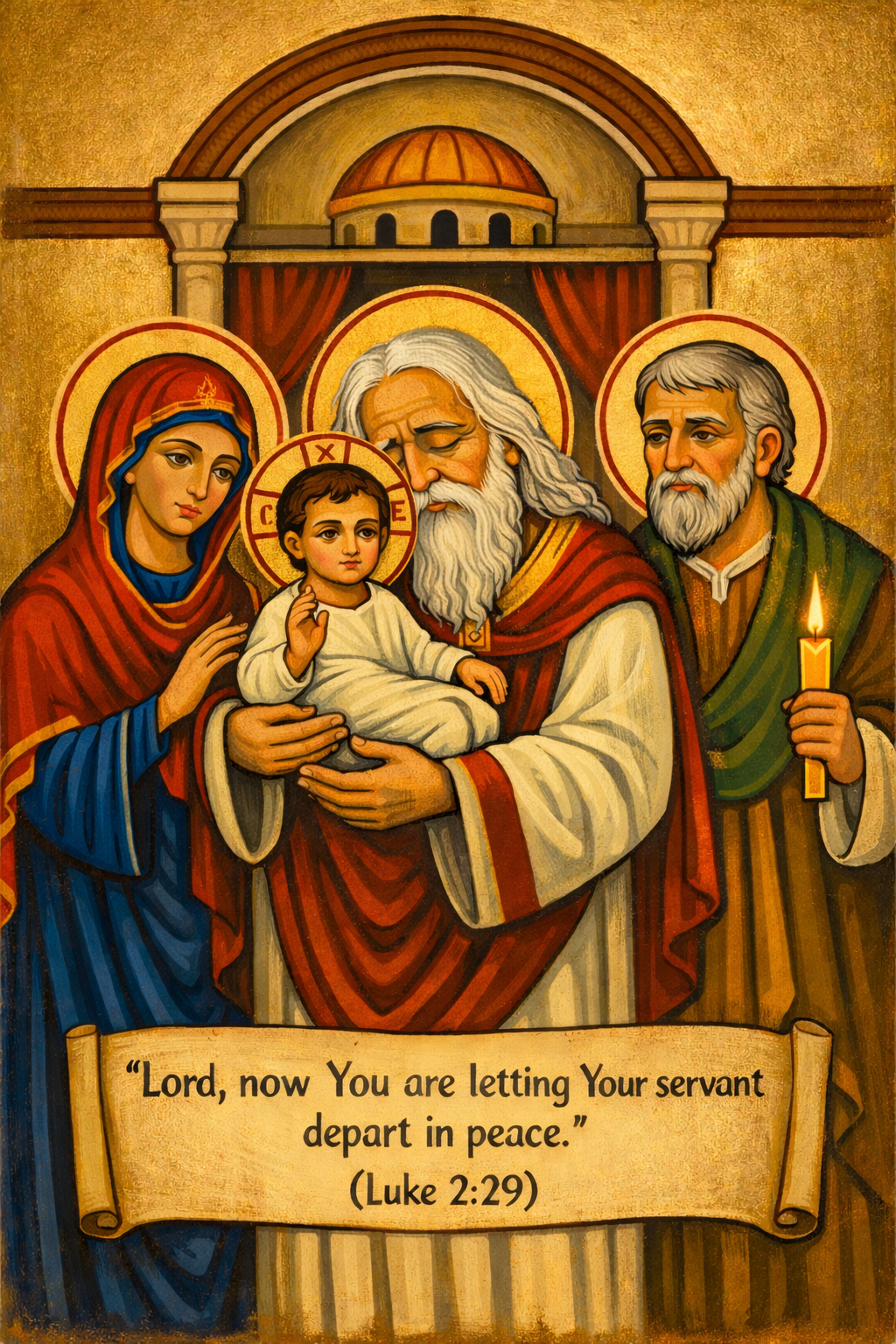
The Entrance of our Lord into the Temple —(Amshir 8, c. February 15)
In the Name of the Father, and of the Son, and of the Holy Spirit, One God. Amen.
My beloved brothers and sisters,
The Church places before us a feast that, in the heart of the Church, is a powerful moment. It is the Feast of the Presentation, the Entry of our Lord Christ into the Temple. Forty days after His birth, the Light of the world enters the House of God, not walking on His own feet, but carried in human arms.
And the Church is asking each one of us a very personal question:
When Christ comes to His Temple, does He find a place in my heart, or only a place in my calendar?
Today, I want to walk with you through this feast in a simple way and give you one practical step you can take with you, so this feast becomes not only a memory but a meeting.
1) Christ enters the Temple in humility, to perfect the Law and heal us
The Gospel says:
“Now when the days of her purification according to the law of Moses were completed, they brought Him to Jerusalem to present Him to the Lord.” (Luke 2:22, NKJV)
This is important. St. Mary did not need purification. Our Lord Jesus Christ is the Holy One. Yet they obeyed the commandment with humility.
They did not come to argue the Law. They did not come to criticize the Law. They came to fulfill it with a quiet spirit.
And the Gospel continues:
“So when they had performed all things according to the law of the Lord, they returned to Galilee, to their own city, Nazareth.” (Luke 2:39, NKJV)
My beloved, Christ did not come to break what God had given. He came to perfect it, to complete it, to reveal its deepest meaning.
And here is something very moving. The Gospel tells us what they offered:
“…a sacrifice according to what is said in the law of the Lord, ‘A pair of turtledoves or two young pigeons.’” (Luke 2:24, NKJV)
This is the offering of the poor. If they were rich, they would have offered a lamb. But they were poor. So they offered what they could.
And this gives us a very gentle lesson. God does not measure the offering by its price. God measures the offering by the heart that brings it.
Some people do not come to God because they feel they have nothing to offer. They say, “I am not spiritual enough.” “I am not consistent.” “I keep falling.” “I do not pray like others.” “I do not understand the Bible.” “My life is messy.”
But look at this holy family. They did not come with abundance. They came with humility.
So I want to say this clearly: If you can only offer God two pigeons, offer them. If you can only offer God one honest tear, offer it. If you can only offer God one sincere sentence, offer it. If you can only offer God a broken heart that is tired, offer it.
Because God receives humility as a precious gift.
2) Simeon teaches us the holiness of waiting, and the reward of faithful endurance
The Gospel then introduces a man whose name we must never forget. It says:
“And behold, there was a man in Jerusalem whose name was Simeon, and this man was just and devout, waiting for the Consolation of Israel, and the Holy Spirit was upon him.” (Luke 2:25, NKJV)
The name “Simeon” (derived from the Hebrew Shimon) means “hearing,” “one who listens,” or “God has heard.” And Simeon truly lived as a man who listened to God.
Righteous Simeon the God-Receiver was, according to the testimony of the holy Evangelist Luke, “just and devout,” “waiting for the consolation of Israel,” and “the Holy Spirit was upon him” (Luke 2:25, NKJV). God had promised him that he would not die until he saw with his own eyes the promised Messiah, Christ the Lord, come into the world.
Ancient historians tell us that the Egyptian pharaoh Ptolemy II Philadelphus (285–247 B.C.) wished to include texts of Holy Scripture in the famous Library at Alexandria, so he invited scholars from Jerusalem, and the Sanhedrin sent their wise men. The Righteous Simeon was one of the seventy scholars who came to Alexandria to translate the Holy Scriptures into Greek. The completed work was called “The Septuagint,” and it is the version of the Old Testament used by the Orthodox Church. While translating the book of the Prophet Isaiah, Saint Simeon read the words: “Behold, a virgin shall conceive in the womb, and shall bring forth a Son” (Isaiah 7:14, NKJV). He thought that the word “virgin” was inaccurate and wanted to correct the text to read “woman,” but at that moment an angel appeared to him, held back his hand, and said, “You shall see these words fulfilled. You shall not die until you behold Christ the Lord born of a pure and spotless Virgin.” From that day,
Saint Simeon lived in expectation of the Promised Messiah. Then, one day, the righteous elder received a revelation from the Holy Spirit and came to the Temple—on the very day, the fortieth after the Birth of Christ, when the All-Pure Virgin Mary and Saint Joseph had come to perform the ritual prescribed by Jewish Law. When Saint Simeon beheld their arrival, the Holy Spirit revealed to him that the divine Child held by the All-Pure Virgin Mary was the Promised Messiah, the Savior of the world. Simeon took the Child in his arms and cried out, “Lord, now You are letting Your servant depart in peace, according to Your word; for my eyes have seen Your salvation which You have prepared before the face of all peoples, a light to bring revelation to the Gentiles, and the glory of Your people Israel” (Luke 2:29–32, NKJV).
My beloved, this is why Simeon becomes the icon of holy endurance. He waited—not with bitterness, and not with impatience—but with reverence, with obedience, and with a heart trained to recognize God when He arrives.
And the Gospel says:
“And it had been revealed to him by the Holy Spirit that he would not see death before he had seen the Lord’s Christ.” (Luke 2:26, NKJV)
My beloved, God knows how to comfort His servants. God knows how to sustain people who are waiting.
Some of you are waiting right now. You are waiting for God to heal something in you. You are waiting for God to fix a relationship. You are waiting for peace in your home. You are waiting for direction in your work. You are waiting for a child to return. You are waiting for repentance. You are waiting for relief from anxiety.
And waiting is not easy. Waiting can make the heart tired. Waiting can make the mind race. Waiting can make a person feel forgotten.
But Simeon teaches us something that the world does not understand: Waiting with God is not wasted time. Waiting with the Holy Spirit is holy time.
Then the Gospel says something beautiful:
“So he came by the Spirit into the temple.” (Luke 2:27, NKJV)
This is the secret. Simeon did not find Christ by accident. He was guided by the Spirit. When a person lives in prayer, when a person stays faithful, the Holy Spirit guides them to meet Christ, sometimes in the most unexpected moment.
And when Simeon saw the Child, the Gospel says:
“…and when the parents brought in the Child Jesus, to do for Him according to the custom of the law, he took Him up in his arms and blessed God…” (Luke 2:27–28, NKJV)
Imagine that moment: old hands holding the Eternal Word, a tired waiter receiving the Promise, a servant embracing his Lord. And Simeon did not start with a long speech. He started with worship.
3) Simeon’s song: Christ is salvation for all, and the Light of the world
Simeon cried out, saying:
“Lord, now You are letting Your servant depart in peace, according to Your word; for my eyes have seen Your salvation which You have prepared before the face of all peoples, a light to bring revelation to the Gentiles, and the glory of Your people Israel.” (Luke 2:29–32, NKJV)
My beloved, this is one of the most precious prayers in the Church. We pray it in Compline in the Agpeya. We pray it in the spirit of Vespers. We pray it when we want peace in our hearts.
Why? Because Simeon is teaching us what peace really is. Peace is not that life has no problems. Peace is that I have seen the Savior.
“Lord, now You are letting Your servant depart in peace.” Why? Because “my eyes have seen Your salvation.”
Notice the words. Simeon does not say, “My eyes have seen a solution.” He says, “My eyes have seen Your salvation.” Christ is not only the One who fixes situations. Christ is the Salvation Himself.
And Simeon says something that the whole world needed to hear: this salvation is “before the face of all peoples.” Not for one group only. Not for one race only. Not for one background only.
“A light to bring revelation to the Gentiles, and the glory of Your people Israel.”
This is why the feast is called Candlemas in many places. Because we light candles to proclaim what Simeon proclaimed: Christ is the Light.
And in our Coptic rite, after the Gospel, the Church does something very tender and very theological. We wrap the Gospel in white, and the priest carries it like a baby, and we process around the altar three times while candles are held by the deacons.
Why? Because the Gospel is not just a book. The Gospel is Christ speaking. The Gospel is Christ present among His people.
When we wrap it like a baby, we are declaring: the Word became flesh. When we carry it, we are declaring: the Church carries Christ to the world. When we circle the altar, we are declaring: Christ is the center of our worship, the center of our life.
And the three processions remind us that the Light leads us to worship the Holy Trinity: Father, Son, and Holy Spirit.
My beloved, this is not a theater. This is preaching with the body. This is theology with worship. The Church is not only telling you Christ is the Light. The Church is making you walk with the Light.
4) The Cross is already present: the sign spoken against, and the sword in Mary’s heart
But the Gospel also shows us that even in a feast full of joy, the Cross is never far. It says:
“Then Simeon blessed them, and said to Mary His mother: ‘Behold, this Child is destined for the fall and rising of many in Israel, and for a sign which will be spoken against’” (Luke 2:34, NKJV)
A sign spoken against. From the beginning, the world will resist Him. Not because He is not good, but because He is too true. Not because He is not loving, but because His love exposes darkness.
Then Simeon says:
“‘Yes, a sword will pierce through your own soul also, that the thoughts of many hearts may be revealed.’” (Luke 2:35, NKJV)
The sword points to the sorrow of the Mother at the Cross.
My beloved, the Church is very honest. She does not give us a sweet story without reality. She tells us: if you follow the Light, you will also face opposition. If you love Christ, you will also carry a cross.
But listen to the purpose: “That the thoughts of many hearts may be revealed.” Christ reveals hearts. Some will fall because they reject Him. Some will rise because they receive Him. And sometimes, even in our own hearts, Christ reveals what we try to hide.
This is where this feast becomes very practical for our spiritual life, and even for our mental health. Many people live with anxiety, not only because life is difficult, but because their hearts are carrying fears they never brought into the light.
Fear of losing control. Fear of being rejected. Fear of failing. Fear of being alone. Fear of the future.
And Christ, the Light, does not come to shame you. He comes to heal you. He reveals what is inside, not to condemn, but to save. He brings hidden thoughts into the light, so they stop poisoning you in the dark.
So if tomorrow you feel convicted, if tomorrow you feel exposed, if tomorrow you feel your heart is stirred, do not run away. That stirring might be the mercy of God.
5) Anna the Prophetess: When you truly meet Christ, you speak hope to others
The Gospel then mentions another holy person in the Temple:
“Now there was one, Anna, a prophetess… She did not depart from the temple, but served God with fastings and prayers night and day.” (Luke 2:36–37, NKJV)
Then the Gospel says:
“And coming in that instant she gave thanks to the Lord, and spoke of Him to all those who looked for redemption in Jerusalem.” (Luke 2:38, NKJV)
Look at this. Anna did not keep the news to herself. When she met Christ, she gave thanks, and she spoke of Him.
My beloved, this is the fruit of a true encounter with Jesus. A person who truly meets Christ becomes a messenger of hope. Not necessarily by preaching on a microphone, but by speaking hope in their home, speaking hope to a friend, speaking hope to a struggling spouse, speaking hope to a child who is lost, speaking hope to someone who is tired.
The Church needs Simeons who wait faithfully, and Annas who speak faithfully.
Spiritual Exercise for Tomorrow: The Simeon Prayer and One Honest Offering
So what is the feast asking from us? It is asking us to do two things: present Christ to God and present ourselves to Christ.
Here is the spiritual exercise. One practice.
First: Take Simeon’s words and pray them slowly, not as a reading, but as a personal cry:
“For my eyes have seen Your salvation.” (Luke 2:30, NKJV)
Say: Lord, I want to see You, not only to hear about You.
Then pray:
“A light to bring revelation…” (Luke 2:32, NKJV)
Say: Lord, bring Your light into the dark places in me.
Second: Offer one honest offering. Not a big promise. Not a dramatic vow. One honest offering.
Offer Him one repentance you have been delaying. Offer Him one forgiveness you have been refusing. Offer Him one confession you have been hiding. Offer Him one act of mercy that nobody will see. Offer Him one decision to return to prayer, even if small.
And if you feel poor, remember the offering of the poor. Two pigeons. But it was accepted. Because God receives humility.
Conclusion
My beloved brothers and sisters, today the Light enters the Temple. But the greater miracle is when the Light enters my heart.
May the Lord grant us the spirit of St. Mary’s obedience, and the patience of Simeon, and the prayer of Anna, and the courage to accept the Cross as the path of true life.
May Christ, the Light of the world, shine in our homes, shine in our thoughts, shine in our relationships, and shine in our Church.
May the Lord bless us, protect us, and grant us to meet Him with joy and repentance, now and forever. Amen.