
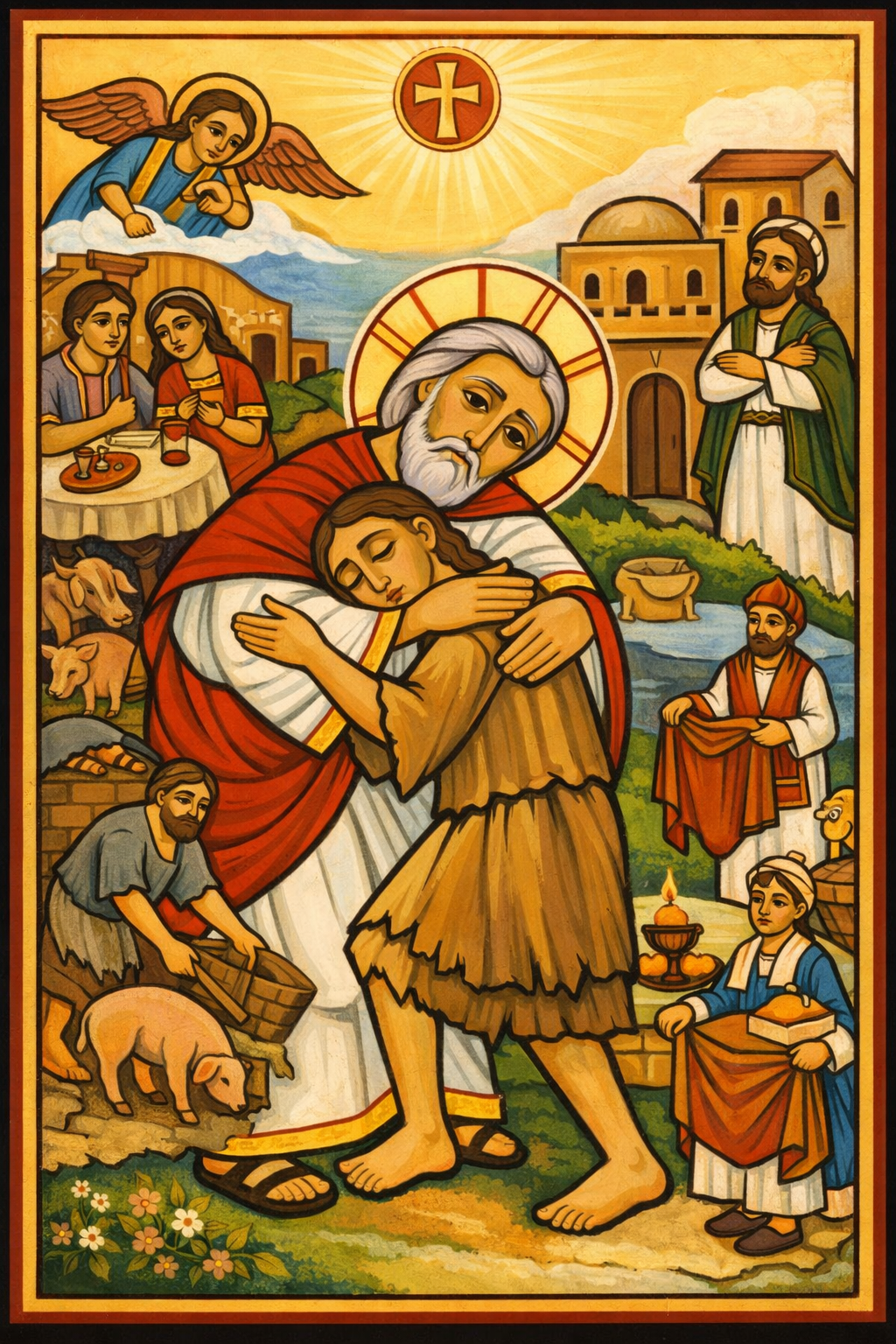
The Prodigal Son: When a Soul Comes Back to Life
“In the Name of the Father, and the Son, and the Holy Spirit, One God. Amen.
May the blessing of the Father who calls us, and His Only Begotten Son who saves us, and the Holy Spirit who sanctifies and transforms us be with us all, that we may hear His word and bear fruit—thirty, sixty, and a hundredfold. Amen.”
My beloved,
Today the Church places before us one of the most beautiful and most healing stories ever spoken by our Lord Jesus Christ: the Parable of the Prodigal Son.
It is not simply a story about a young man who made bad decisions. It is a story about every human soul. It is a story about distance, awakening, repentance, and the boundless mercy of God.
The Gospel tells us that the young man took his inheritance, left his father’s house, and went into a far country. There he wasted everything in reckless living.
But the most important moment in the entire parable is not when he left, and it is not even when he returned.
The turning point of the whole story is found in one sentence:
“But when he came to himself…” (Luke 15:17, NKJV)
The Gospel does not say he came to his father first. It says he came to himself.
This is where repentance begins.
Point One: Sin Is a Form of Spiritual Forgetfulness
The young man did not start his journey in the pigsty.
He started it in his father’s house.
He had love. He had belonging. He had dignity.
But slowly something happened inside him. He began to believe a lie.
The lie that says, “Life will be better if I live it my own way.”
This is the ancient lie of the serpent.
The prodigal son thought freedom meant leaving the father. But what he discovered is that life without the father leads to slavery.
“Then he went and joined himself to a citizen of that country, and he sent him into his fields to feed swine.” (Luke 15:15, NKJV)
The son who once sat at his father’s table is now feeding pigs.
Sin always works like this. It promises freedom, but it produces bondage.
“Sin is a tyrant that promises pleasure, but in the end it enslaves the soul and makes it poorer than before.”—St. John Chrysostom
Let me give you a real example.
In the early centuries of the Church, there was a man named St. Moses the Black. Before he became a saint, he lived like the prodigal son in the far country. He was a robber, a violent man, feared by everyone. He stole, fought, and lived in sin. His life was powerful on the outside, but empty on the inside.
One day, something strange happened. He lifted his eyes to the sun and cried out, “O sun, if you are God, let me know it. And you, O God whom I do not know, let me know you.” Even in the darkness of sin, his soul remembered that there must be something greater.
Eventually, he went to the desert, met the monks of Scetis, and his life changed completely. The robber became a saint, a father of monks, and a priest of the Church. The one who once terrified others became a comforter of souls.
My beloved, sin always begins with forgetfulness: forgetting who we are, forgetting where we belong, forgetting our Father. But the soul was never created to live far from the Father.
Point Two: Repentance Begins When We Come to Ourselves
The most beautiful sentence in the parable is this:
“But when he came to himself...” (Luke 15:17, NKJV)
The young man suddenly woke up.
He realized the truth. He realized where he was. He realized what he had lost. He realized who he had become.
The Fathers of the Church often say that sin is a kind of spiritual madness. Repentance is the moment when a person regains clarity.
“When the prodigal came to himself, he returned to a sound mind. For sin had made him foolish, but repentance restored his understanding.”—St. Cyril of Alexandria
My beloved, repentance is not humiliation. Repentance is healing.
Let me tell you about another powerful moment like this.
There was a woman in the early Church named St. Mary of Egypt. For many years, she lived in deep sin and immorality. She herself later admitted she lived only for pleasure.
One day, she traveled to Jerusalem and tried to enter the Church of the Holy Sepulchre. But something mysterious happened. Every time she tried to walk through the door, she could not enter. Others passed freely, but she was stopped.
Suddenly, she understood. Her life had closed the church’s door. At that moment, she came to herself.
She fell down before an icon of the Virgin Mary and cried out in repentance. From that moment, she left her old life completely and spent the rest of her life in the desert in repentance and prayer.
Repentance begins the moment a person says, “I cannot continue like this. I was not created for this life of emptiness.”
This is why confession is not a punishment. Confession is coming back to reality. It is the moment when the soul says, “I want to live again.”
Point Three: The Memory of the Father Awakens Hope
When the prodigal son came to himself, he remembered something powerful: his father.
“How many of my father’s hired servants have bread enough and to spare, and I perish with hunger!” (Luke 15:17, NKJV)
He remembered the abundance of his father’s house. Even the servants had bread. That memory awakened hope.
This is one of the enemy’s cruelest works: to make us forget the goodness of God. He wants us to believe that God is distant, harsh, and unwilling to receive us. But the prodigal son remembered something different. He remembered that his father was generous. He remembered that there was bread in his father’s house. He remembered that mercy still existed there.
And sometimes, my beloved, repentance begins exactly there: not with strength, but with memory. The soul remembers what it once knew. The heart remembers the peace it had in God. The conscience remembers that the Father’s house was always better than the far country.
One of the clearest examples of this awakening is St. Augustine.
For many years, Augustine chased pleasure, philosophy, ambition, and pride. He searched everywhere for happiness, but nothing satisfied his soul. Outwardly, he was brilliant, admired, and accomplished. Inwardly, he was restless, wounded, and hungry for truth.
In his autobiography Confessions, St. Augustine describes the decisive moment of his conversion. While in deep inner struggle, he suddenly heard a child’s voice repeating a mysterious phrase that changed the direction of his life:
“I heard the voice of a boy or girl… chanting and repeating, ‘Take up and read, take up and read.’
I seized the book, opened it, and read silently the first passage my eyes fell upon:
‘Not in rioting and drunkenness… but put on the Lord Jesus Christ.’
Instantly, as the sentence ended, a light of relief from all anxiety flooded my heart.”
Reference: St. Augustine of Hippo, Confessions, Book VIII, Chapter 12.
“Not in revelry and drunkenness, not in lewdness and lust, not in strife and envy. But put on the Lord Jesus Christ.” (Romans 13:13–14, NKJV)
At that moment, Augustine remembered the Father’s house.
Later, he wrote one of the most famous lines in Christian history:
“You have made us for Yourself, O Lord, and our hearts are restless until they rest in You.”
The soul that remembers God can never remain satisfied in the far country.
This is the mystery of repentance. We do not return to God because we deserve forgiveness. We return because His mercy is greater than our failure, and because somewhere deep within us, the heart still remembers the Father’s house.
Point Four: Repentance Requires a Decision
The prodigal did not stop at regret.
He made a decision.
“I will arise and go to my father.” (Luke 15:18, NKJV)
Three words changed his life:
“I will arise.”
Repentance is not only feeling sorry. Repentance is a new direction.
This reminds us of St. Anthony the Great.
One day, Anthony was standing in church and heard the Gospel reading:
“If you want to be perfect, go, sell what you have and give to the poor… and come, follow Me.” (Matthew 19:21, NKJV)
Anthony did not admire the verse. He obeyed it immediately.
He sold everything he had, gave the money to the poor, and went into the desert to live for God. The entire monastic movement of the world began because one young man heard the Gospel and said with his life, “I will arise.”
My beloved, many people feel regret. Many people say, “I should change. I should return to God. I should pray more. I should confess.” But repentance begins the moment we say, “I will arise.”
“Let no one despair of himself. Even if you have fallen into the deepest pit of sin, you can still rise again through repentance.”—St. John Chrysostom
God is not asking us to be perfect. He is asking us to stand up and come home.
Point Five: The Father Runs Toward the Returning Soul
The most astonishing moment in the entire parable happens when the son is still far away.
“But when he was still a great way off, his father saw him and had compassion, and ran and fell on his neck and kissed him.” (Luke 15:20, NKJV)
The father ran.
In ancient Middle Eastern culture, dignified men did not run. But love was stronger than dignity.
The father must have been watching the road every day. Waiting. Hoping. Praying.
This is the heart of God.
“The father did not wait for the son to speak, but embraced him immediately, showing that God hastens to forgive those who return.”—St. Cyril of Alexandria
There is a beautiful desert story about St. Macarius the Great.
One day, a young monk fell into sin and was ashamed to return to the monastery. He believed God would never forgive him. But St. Macarius sent someone to find him and bring him back.
When the monk returned, trembling with fear, St. Macarius embraced him and gently restored him. He did not crush him. He did not shame him. He received him with mercy and gave him hope.
That is the image of the father in the parable.
The son came prepared with a speech: “Father, I have sinned against heaven and before you, and I am no longer worthy to be called your son.” But the father interrupted him. He restored him. He clothed him. He celebrated him.
Because repentance does not make us servants again. Repentance restores us as sons and daughters.
A Word for Our Hearts Today
My beloved, every one of us in this church today is somewhere in this story.
Some of us are still in the far country. Some of us are sitting in the pigsty of disappointment or sin. Some of us are already walking back toward the Father.
But the message of the Gospel is this:
It is never too late to return.
The Father is still watching the road.
The Father is still waiting.
The Father is still ready to run.
All heaven rejoices when even one soul returns.
A Practical Lesson for This Week
Let us take one simple step this week.
Take five quiet minutes.
Ask yourself three questions:
- Where in my life have I wandered away from God?
- What is the pigsty that is draining my soul?
- What step can I take to arise and return?
- Maybe it is prayer.
- Maybe it is forgiveness.
- Maybe it is a scheduling confession.
- Maybe it is repairing a relationship.
Whatever it is, do not stay in the far country.
Arise and return to the Father.
Because the moment you begin walking toward Him, He is already running toward you.
“May the Lord bless us, transform our hearts and minds, that our homes may stand on the Rock, our hands serve in the harvest, and our hearts long for Heaven. Amen.”