
Where Is God in My Suffering? – The Life of Job and the Wisdom of the Cross
In the Name of the Father, and the Son, and the Holy Spirit, One God. Amen.
May the blessing of the Father who calls us, and His Only Begotten Son who saves us, and the Holy Spirit who sanctifies and transforms us be with us all, that we may hear His word and bear fruit—thirty, sixty, and a hundredfold. Amen.
1. Opening
My beloved, every one of us has asked it — even if only in the silence of our own heart: “Why is this happening to me? Where is God right now? Has He forgotten me?” If you have never asked these questions, you have not yet lived long enough, or you have not yet loved deeply enough. To live in this world, and to love in this world, is to suffer in this world.
And so the Holy Spirit gave us a whole book in the Bible for people who are asking exactly these questions. The book of Job. Forty-two chapters. One suffering man. And a God who, in the end, shows up — not with an explanation, but with Himself.
2. Who Was Job?
Job was a real man. He lived in the time of the patriarchs, around the days of Abraham, in a land called Uz, east of the Holy Land. He was not even an Israelite. He had no Bible, no Temple, no priesthood. And yet — listen to this — Job knew God. Job feared God. Job walked with God.
He had ten children — seven sons and three daughters. He was the wealthiest man in the East. He was a father to the poor, eyes to the blind, and feet to the lame. And every morning he rose early to offer sacrifices for each of his children, in case any of them had sinned in their hearts. God Himself said of him: “There is none like him on the earth, a blameless and upright man, one who fears God and shuns evil” (Job 1:8). This is the man who is about to lose everything.
Reflection:
God had one Son on earth without sin, but never one without suffering.
3. Righteous — But Not Exempt
Here is the first lie I need to kill today. The lie says: “If I am a good person, if I pray, if I fast, if I keep the Church, then God owes me a safe and comfortable life.” My beloved, that is not Christianity. That is a business transaction. Job was the most righteous man of his generation, and Job lost everything. Being a faithful Christian does not make you exempt from suffering. It makes you able to suffer with hope. There is a world of difference between those two things.
4. The Collapse — When Life Falls Apart
And then came the day. One day, my beloved. The Bible says, “Now there was a day…” and in one afternoon, everything Job had built came crashing down.
A messenger comes running: the Sabeans took the oxen and killed the servants. While he is still speaking, another comes: fire from heaven burned up the sheep. While he is still speaking, another comes: the Chaldeans raid the camels. And while that one is still speaking — can you feel it? — a fourth messenger comes, and this is the one no parent ever wants to hear:
Your sons and daughters were eating and drinking wine in their oldest brother’s house, and suddenly a great wind came from across the wilderness and struck the four corners of the house, and it fell on the young people, and they are dead; and I alone have escaped to tell you! — Job 1:18–19 (NKJV)
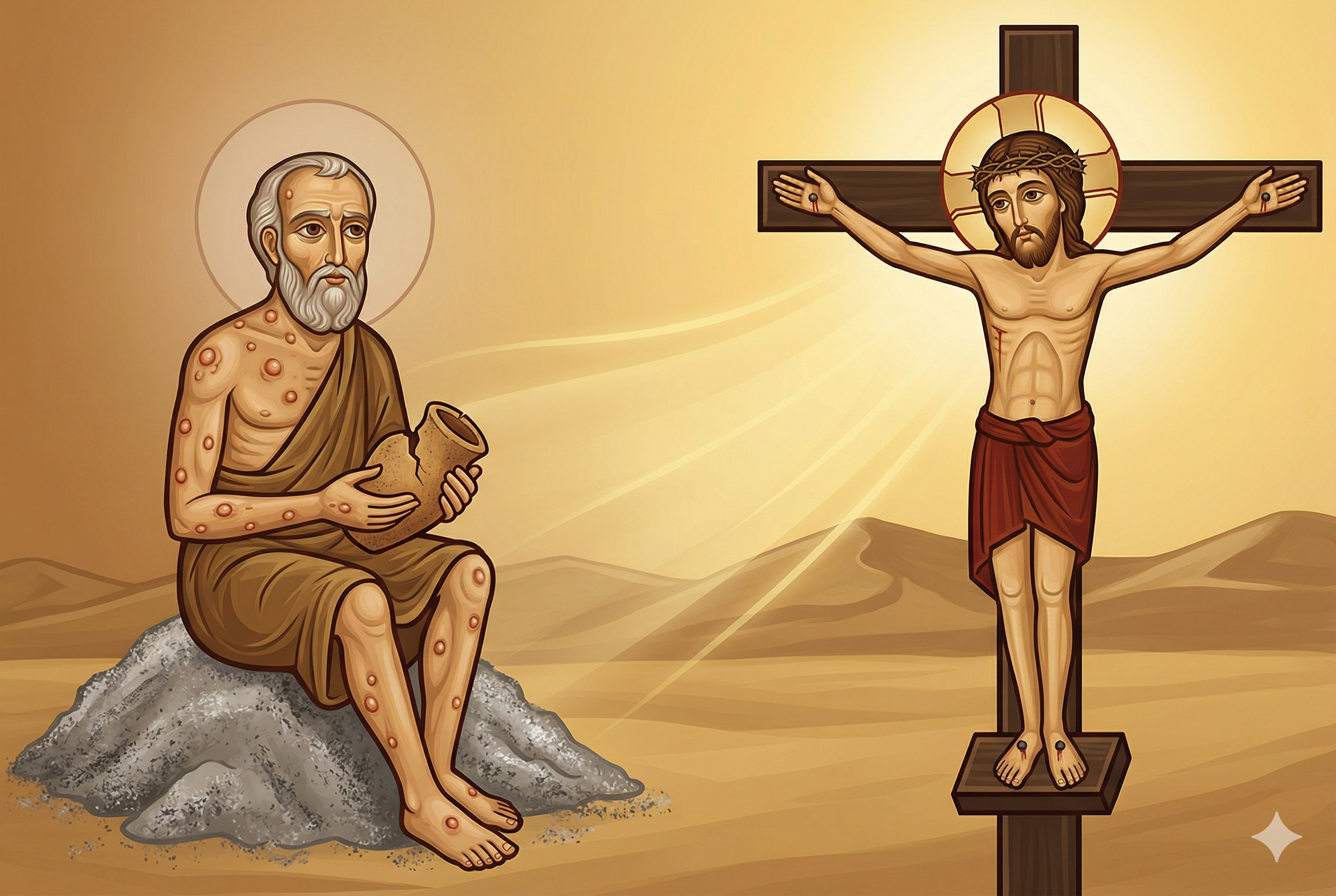
Ten children. All ten. In one moment. And then his health is taken — boils from the sole of his foot to the crown of his head. He sits in a pile of ashes, scraping his sores with a piece of broken pottery.
And then watch what Job does. He tears his robe. He shaves his head. He falls to the ground — and he worships. He says, “The Lord gave, and the Lord has taken away; blessed be the name of the Lord” (Job 1:21). My beloved, faith does not mean pretending the wound does not hurt. Job grieved loudly, honestly, and physically. But in the middle of his grief, he worshiped. He worshiped from the floor of his own broken life.
Reflection:
“Do not be surprised if you fall every day and do not surrender. Stand your ground courageously.”
5. Honest Questions and Wrong Voices
But the book does not end at chapter 2. For thirty-seven more chapters, Job cries, questions, and screams at God. He says, “I cry out to You, but You do not answer me” (Job 30:20). And the Holy Spirit left those words in the Bible on purpose — because God wants you to know that it is not a sin to bring your honest pain to God. Laments are not a failure of faith. Laments are the language of a soul that still believes enough to keep talking.
Job’s three friends came to comfort him. For seven days they sat in silence with him, and that was holy. But the moment they opened their mouths, they ruined it. They told Job his suffering must be his fault. They crushed a broken man under the weight of their theology. And at the end of the book, God Himself rebuked them — not Job. So when you visit the suffering, my beloved: do not explain. Do not say “everything happens for a reason.” Come, sit, weep, hold a hand. Your presence is the sermon.
Reflection:
“Acquire a peaceful spirit, and thousands around you will be saved.”
6. God’s Answer — Revelation, Not Explanation
Finally, God Himself speaks. And what does God say? God never tells Job why. Not once. God never lifts the curtain. Instead, God asks Job seventy questions: Where were you when I laid the foundations of the earth? Have you walked in the springs of the sea? Have the gates of death been revealed to you?
Because the book of Job is not really about suffering, my beloved. The book of Job is about God. Suffering is only the catalyst. The names of God appear over one hundred and eighty times in this book. Everyone keeps talking about God. And at the end, Job opens his mouth and says these unforgettable words:
I have heard of You by the hearing of the ear, but now my eye sees You. Therefore I abhor myself, and repent in dust and ashes. — Job 42:5–6 (NKJV)
Do you understand what Job is saying? “All my life I knew about You. Now I know You. I see You.” My beloved, you will learn more about God in one week of suffering than in ten years of comfort. Job asked God, “Why?” God never answered “Why.” God answered, “I AM.” And that was enough.
Reflection:
“The one who has come to know God prefers Him above all things.”
7. Job and the Cross
But I cannot end in the book of Job, because the book of Job itself is reaching forward. It is leaning into the future. It is asking a question that only one answer in all of history can satisfy — and that answer is a Person, hanging on a Cross outside the walls of Jerusalem.
♰ Look at Job, and look at Christ. Job was blameless — Jesus was sinless.
♰ Job was accused by Satan in the heavenly council — Jesus was accused by Satan in the wilderness.
♰ Job lost everything — Jesus emptied Himself of everything.
♰ Job sat on a pile of ashes — Jesus hung on a Roman cross.
♰ Job cried, “Why?” — Jesus cried, “My God, My God, why have You forsaken Me?”
♰ Job is the shadow. Christ is the reality.
The relatively innocent sufferings of Job foreshadow the utterly innocent sufferings of Jesus Christ — and only the sufferings of Christ can save.
And from his ash heap, two thousand years before Calvary, Job somehow saw it. He cried out: “For I know that my Redeemer lives, and He shall stand at last on the earth… in my flesh I shall see God” (Job 19:25–26). Job was reaching forward to Christ. And we — we live on the other side of the Cross. We know the Redeemer’s name. His name is Jesus.
When you suffer as a Christian, you do not suffer alone. God’s answer to every “Where is God in my suffering?” is Jesus Christ, arms outstretched on the cross, saying: “Here. I am here. I have always been here. I am here with you, and I am here for you.”
8. Three Things to Take Home
My beloved, take three things with you this morning.
First — give yourself permission to grieve. Tear your robe if you have to. Weep. Faith does not mean pretending. Job worshiped with tears running down his face.
Second — keep talking to God, even when you are angry at Him. Do not walk away. Walk toward Him, even with your fists clenched. The devil wants the conversation to stop. God wants it to continue.
Third — trust without answers. Job never got the answer to “why.” He got something better. He got God. And so will you. Hold on to two things in the dark: the character of God, and the Cross of Christ.
9. Closing
If you are here today and you are sitting in the ashes of what used to be your life — if the messengers have been coming, one after another — I have one word for you. It is not an explanation. It is a name.
Jesus.
Jesus knows. Jesus sees. Jesus has been there. Jesus is with you now. And Jesus has the final word — and His final word is not darkness. It is morning. It is an empty tomb. It is His own face, bending over yours, and wiping the tears away with His own pierced hand.
God is not watching your suffering from a distance. God is inside your suffering, suffering with you, and carrying you home. Hold on to Him. Do not let go. Even if you cannot feel His hand, His hand is holding yours. And He will not let you fall.
May the Lord bless us, transform our hearts and minds, that our homes may stand on the Rock, our hands serve in the harvest, and our hearts long for Heaven. Amen.